
I slept well. It was quiet. Real quiet. With the exception of the wind howling through the night, not a single peep reached my ears. My closest neighbor was maybe fifty yards away. Just far enough to feel like I had the desert to myself, but close enough that I wasn’t entirely alone in this vast emptiness.
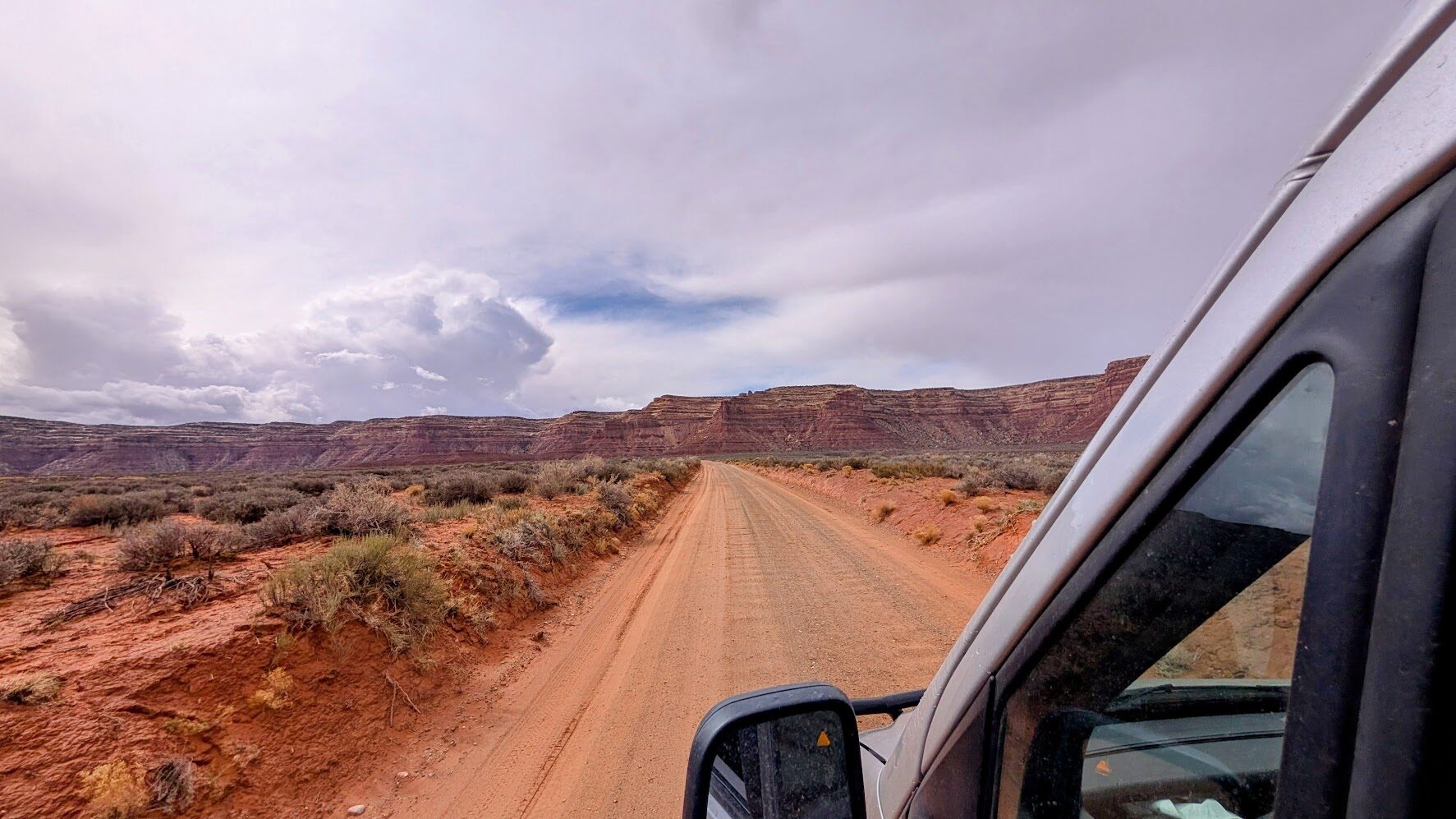
When morning came, I woke to a view that looked like something painted by the gods themselves. You can see it in the photo — the red earth stretching out, the stone towers rising on the horizon, and the Mountains in the far distance dusted with fresh snow. It had clearly stormed in the night. The air was frigid where I was, but those white-capped ridges off in the distance must have been absolutely frozen.
I checked the Starlink for a weather update and learned the low had dropped to 27 degrees. Chilly, but survivable. The coming night, though, was predicted to plunge to 23. That’s flirting with the danger zone for my water system, and I had no desire to risk a burst pipe in the middle of nowhere.

Still, before I figured out where I’d lay my head next, there was something I knew I couldn’t miss: the 17-mile dirt road that winds through the Valley of the Gods. The map called it San Juan County Road #242, but that name hardly captures what it feels like. This isn’t just a back road. It’s a ribbon of history cut through 250-million-year-old sandstone, a place where Navajo legends describe the rock spires as warriors turned to stone. Early settlers later gave them names like Seven Sailors, Lady in the Bathtub, and Battleship Rock.

Driving it is part adventure, part meditation. On a dry day, even a cautious two-wheel drive can usually manage the loop, but a single rainstorm can turn the clay to muck, leaving even the most rugged 4x4s spinning in frustration. It’s the kind of road that makes you slow down — not just because you have to, but because you want to. Out here, ten miles an hour feels just right.
So I packed up loose, no hard agenda. I didn’t know exactly where I’d sleep that night, but I knew where my day would begin: rolling straight into the Valley of the Gods.
Before heading off, I aired down my tires — something I don’t usually bother with unless I expect a long stretch of rough terrain. Dropped them to 25 psi in the front and 35 in the back, just enough to soften the ride for the old Redneck Ferrari. This loop isn’t paved highway; it’s a washboard of graded clay and gravel, carved into the desert floor. Lowering the tire pressure helps the suspension absorb the chatter and gives you a little more bite on the loose patches.
I slowly and gently worked my way out of the camping area I’d tucked into the night before. The road was rough and uneven, and I had to pivot left and right to keep my rear cargo boxes from bottoming out. Right away, I could feel the payoff from airing down the tires — the ride was noticeably smoother, the bumps softened just enough to keep things comfortable.
For the next twenty or thirty minutes I rolled along, stopping here and there to take pictures and just let the landscape sink in. “Jaw-droppingly beautiful” doesn’t even cut it. Every turn of the road revealed a new fortress of sandstone or a spire that looked like it belonged in a myth.
Traffic on the loop is its own rhythm. Every so often I’d pass another vehicle, or one would crawl past me, and each time there was the same polite little standoff: “You go first.” Nobody out here is in a hurry — and that’s part of the magic.
Eventually I found this little pull-off where the road snaked around into another section of the valley. I parked for a while and just soaked it in. From where I stood I could see a glorious ridge-top camp spot further in, one of those sites that makes you think, I’ve got to come back here someday and spend the night.
Strangely enough, most people seem to cluster their camps near the start of the loop, right by the gate. I had done the same, without really questioning it. But as you go deeper, the valley opens up into this vast silence, and hardly anyone stays out there. Maybe it’s the comfort of being near the entrance, maybe it’s the thought of having to bounce your way back out in the dark. Either way, it left me with the sense that I was peeking into a more secret part of the Valley — one that most folks drive through but never truly sit with.
What a special place to be alive in.

I started rolling deeper into the valley, toward the stretch I’d seen earlier where snow still clung to the cliffs, melting fast in the morning sun. But as I drove, the weather turned on me. One minute it was clear, the next I was drifting into bursts of hail. Nothing heavy, just pellets rattling on the windshield, but strange enough to feel like the desert was throwing me a curveball.
It’s a reminder out here — the desert isn’t always the scorched, sunbaked stereotype we picture. These mesas and buttes sit at over 5,000 feet, and the weather can swing wildly. A bright sky can fold into a storm in minutes. Even a light rain can turn this clay road into a skating rink, which is why locals will warn you to always check the forecast before heading in.
I hadn’t anticipated it being this cold, especially during the middle of the day. But that’s the nature of traveling loose. You don’t plan every detail, you just roll with it. Most days that feels like freedom. On days like this, it feels like the land reminding you who’s really in charge. When you roll with the punches, sometimes you get punched.

I kept winding my way deeper through the Valley, trying my best to stay present and soak in the beauty around me instead of getting wrapped up in logistics. Truth was, I had no idea where I was going to sleep that night, and it was starting to dawn on me that I still had a lot of miles ahead of me before the day was done.
But that’s part of the deal out here. You trade the certainty of a neat itinerary for the freedom of just being. And as I looked out at the sandstone giants on either side of the road — formations that the Navajo once described as frozen warriors — it was hard to feel too concerned. The road might have been uncertain, but the land itself was steady, timeless.
So I kept rolling forward, window cracked, the cold air spilling in, loving every minute of it.

I pulled over for a quick lunch break, stretched my legs, and took care of the usual “roadside bathroom stop” routine. While I was at it, I sent a quick text to my wife to let her know all was well — Starlink doing its job even out here in the middle of this wild landscape.
Sitting there with a sandwich in hand, I couldn’t help but just stare at the view. The red earth at my feet, streaks of pale green sagebrush, the rusty cliffs stacked with white bands of ancient sandstone, and above it all, a sky that kept shifting between bright blue and heavy cloud. It was a painter’s palette of desert colors, the kind you don’t just see but feel.
Lunch didn’t last long — it wasn’t about the food anyway. It was about taking a moment to breathe it all in before climbing back behind the wheel and continuing on through the Valley.

By the time I rolled out to the other entrance gate, it was late afternoon — 3:57 PM according to the dash. The Valley loop was behind me, but I still had one problem: where the heck was I going to sleep that night? The temps were forecast to plunge again, and a weather alert had just popped up on my phone. That was enough to put me on edge.
First things first: tires. I pulled off, popped the hood, and dug out my little air compressor setup. It’s a rig I cobbled together myself — a 12V inflator with an extended power cable so I can reach all four corners without hassle. It gets the job done fast, but here’s the part I still haven’t solved: the van has to be on while it’s running. Which means I’m standing out there in the middle of nowhere with the engine idling, doors unlocked, and this nagging thought in the back of my head — what if someone just jumped into the driver’s seat and took off?
It’s a silly worry, maybe, especially out here where the nearest human feels miles away. But standing alone in that red-dirt lot, with the compressor buzzing and the wind pushing through the canyons, it hit me just how vulnerable you can feel on the road. Out here, you’re your own mechanic, your own lookout, your own safety net.

Back inside the van, I finally started to settle on a plan. There was so much more I wanted to do in this corner of Utah, but the weather had other ideas. That’s the tax you pay for loose planning, I suppose, sometimes it buys you freedom, sometimes it costs you experiences. This time, it was costing me another night under the Valley’s stars.
I pulled up the forecast for everywhere within striking distance, and the verdict was clear: the only place remotely warm enough to ride out the cold front was Sedona. Trouble was, Sedona was four and a half hours away if everything went perfectly. (Spoiler alert: it didn’t.)
Still, I knew I couldn’t risk freezing pipes or worse, so I pointed the van south. Before hitting the road, I searched for a place to stay. Sedona isn’t exactly BLM country — it’s a polished, high-dollar town, and cheap camping options vanish as quickly as a cold beer in July. I figured the odds were slim, but I called the one RV park in town anyway.
Luck finally smiled on me: someone had canceled just minutes before. I snagged the very last spot, paid over the phone, and told them not to expect me until late. Relief washed over me. At least I had a target now — even if it was hours away.

Next Leg of this Jahmazing Journey:
Previous Leg of this Jeopardized Journey:
Leave a Reply